
Outsourcing is often associated with transferring work tasks to external providers so they can be completed more efficiently or at lower cost.
However, in many professional service firms the challenge is slightly different.
Some important tasks are simply not being done at all.
Many SME professional service firms are unable to deliver services that their clients would value because the firm lacks the time, skills or resources required to develop them. In other cases the opportunity may not yet have been recognised.
This situation is not unusual. It is largely the result of how professional service firms are structured.
The Consequence of Technical Focus
Professional service firms employ people with deep domain expertise. Lawyers, accountants and surveyors are trained to deliver highly specialised technical services.
Those services are also how firms generate revenue. Most professional services are charged based on time and expertise, which means that technical delivery naturally becomes the primary focus.
The result is predictable.
When technical professionals prioritise their work, they focus first on the tasks that are both urgent and important.
This dynamic is illustrated by a well known prioritisation model:
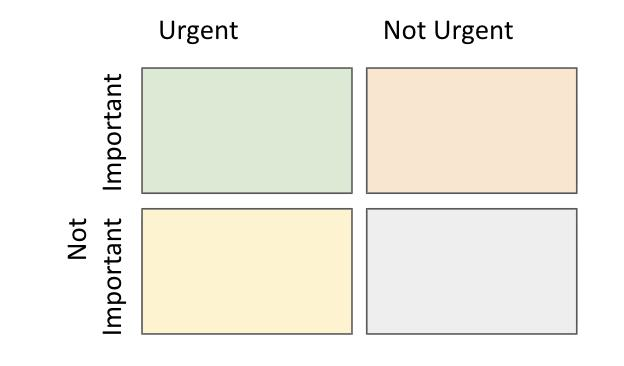
The model, commonly known as the Eisenhower Matrix, divides work into four categories based on urgency and importance.
Technical experts in professional service firms naturally spend the majority of their time on work that sits in the urgent and important quadrant. This is the work that directly serves clients and generates revenue.
That focus is entirely rational. It benefits both the firm and its clients.
However, the model also highlights another category of work that often receives less attention.
The Important but Not Urgent Problem
The Eisenhower approach suggests that important but not urgent tasks should still be addressed deliberately.
In practice, many SME firms struggle to do this.
There are two reasons.
First, highly trained professionals rarely have spare capacity. Their time is already committed to delivering urgent work.
Second, many of these tasks fall outside the firm’s technical expertise. They may involve service development, process improvement, client engagement initiatives or other non-technical activities.
The result is that these tasks are often postponed.
Over time they move into the category of work that will be addressed “when time allows”.
Unfortunately that time rarely appears.
This leads to a second consequence that many firms do not immediately recognise.
The Emergence of Underserved Clients
When important tasks are postponed indefinitely, some client needs remain unaddressed.
The situation can be illustrated simply:
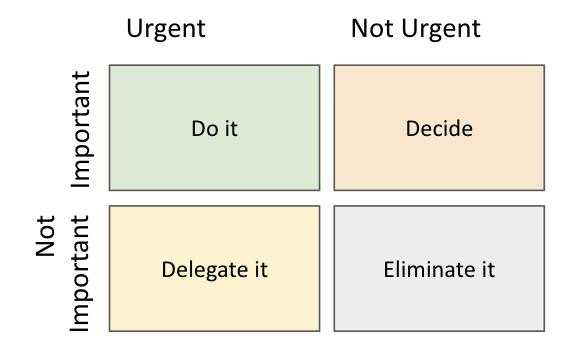
The blue area represents the full range of client needs. The grey area represents the services the firm currently provides.
Where those areas overlap, the firm is meeting client needs effectively.
However, where client needs extend beyond current services, a gap appears. These are the clients whose needs are important but not currently addressed.
In effect, they become underserved.
This creates two risks.
First, potential fee income remains unrealised.
Second, those clients may look elsewhere to have those needs met.
Both outcomes weaken the firm’s position over time.
Becoming Deliberate
Many organisations have recognised that outsourcing can provide a practical solution to this problem.
Outsourcing allows firms to address important tasks without diverting their technical experts away from core client work.
This approach is increasingly common. Across the UK, nearly half of organisations now outsource some aspect of their operations, and many expect that proportion to grow further in the coming years.
The shift reflects a broader change in how outsourcing is viewed. It is no longer simply a cost reduction strategy. Increasingly it is used to provide flexibility, access specialist capabilities and support service innovation.
For SME professional service firms in particular, outsourcing can make capabilities available that would otherwise be difficult to maintain internally.
Introducing PSOut
PSOut helps professional service firms make deliberate decisions about the important tasks that currently remain unaddressed.
Our specialist outsourced services allow firms to extend their offering while maintaining focus on the technical work that defines their expertise.
Importantly, our approach does not remove control from the firm. Instead, we work alongside existing teams to deliver specific initiatives that add value to both the firm and its clients.
In doing so we help firms address underserved areas of their client base without compromising their day to day priorities.
The result is a stronger client relationship, greater differentiation in the market and the opportunity to generate additional income from services that might otherwise never have been developed.