
Many professional service providers do not see themselves as salespeople. Lawyers, accountants, surveyors and consultants tend to think of their work as advisory rather than commercial.
Yet the commercial reality is unavoidable. Clients choose one firm instead of another every day.
Smart firms do not leave those decisions to chance. They think carefully about why clients buy and position themselves accordingly. Understanding how people make buying decisions is one of the most powerful ways to improve both the quantity and quality of new work.
You Are Probably Not Unique
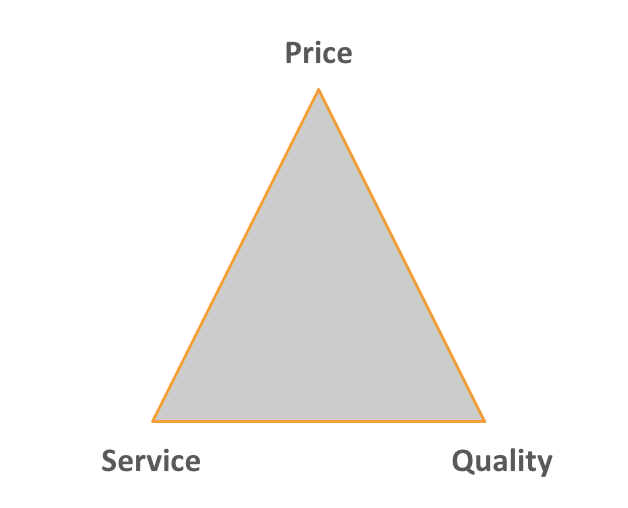
Selling something that is genuinely unique is relatively simple. If a service solves a clear need or desire and no one else offers it, the buyer’s decision is straightforward.
Unfortunately, this position is rarely available to professional service firms.
Most professional services operate within well-established frameworks. Consider conveyancing in a house purchase. The legal process is defined and broadly similar across firms. The same applies to many accountancy, survey or compliance services.
From the buyer’s perspective, firms often appear interchangeable.
A potential client who has no existing relationship with your firm simply sees several providers offering what appears to be the same service. If nothing else distinguishes them, the decision often comes down to price.
That dynamic is uncomfortable but familiar. If price becomes the only factor, the cheapest provider tends to win.
Over time this leads to pressure on margins and can eventually erode service quality. Few firms want to compete purely on price, and most clients would not benefit from such a race to the bottom.
The question then becomes clear.
If buyers are not choosing purely on price, what influences their decision?
Becoming Intentional: Think REP
A useful way to think about buying decisions is through a simple framework called REP.
REP stands for:
Relationship. Ease. Price.
When buyers are choosing between broadly similar options, these three factors usually determine the outcome.
Relationship
Relationships are often the starting point for buying decisions.
Anyone familiar with networking will recognise the phrase know, like and trust. People naturally prefer to work with individuals and firms they already know, or those recommended by trusted contacts.
Existing relationships therefore carry significant weight.
However, relationships are not limited to personal introductions. Potential clients also form impressions through what they observe. Your website, professional profiles, case studies and team biographies all contribute to how your firm is perceived.
These signals shape whether a prospective client feels comfortable approaching you.
Two simple questions can help here:
- Who are your ideal clients?
- How does your firm intentionally build relationships with them?
Firms that answer these questions clearly tend to create stronger and more consistent client connections.
Ease
Convenience matters more than many firms realise.
Modern consumers have become accustomed to extremely smooth user experiences. Companies such as Amazon have demonstrated how powerful ease and convenience can be when selecting between otherwise similar options.
Professional services are not immune to the same expectations.
If engaging with a firm feels complicated, slow or unclear, potential clients may simply choose a provider that feels easier to deal with.
Examining the process from the client’s perspective can reveal simple improvements. Small adjustments often remove friction and make the entire experience more appealing.
Walking through the engagement journey as a client would experience it is a useful exercise. It highlights where clarity, speed or simplicity could improve the experience.
Sometimes the best ideas come from outside the sector. Looking at how other industries design client journeys can provide valuable inspiration.
Price
Price will always play a role in buying decisions.
However, buyers rarely pay a premium without a clear reason to do so.
Higher prices are usually justified when the buyer believes the service offers greater value. That value may appear through stronger service, clearer communication, better reliability or a more reassuring client experience.
The challenge for professional firms is that simply stating quality is rarely convincing.
Clients respond more strongly to evidence than to claims. Demonstrating how the firm delivers quality and service is far more persuasive than simply asserting it.
It is also worth remembering that most clients outside your profession are not particularly interested in technical credentials or industry awards. What they care about is the outcome and the experience of working with the firm.
Why This Matters
Understanding how people buy allows firms to position themselves intentionally.
Without that awareness, firms often present broad and generic offers to the market. Buyers then default to comparing price because there is little else to distinguish between providers.
By contrast, firms that think carefully about Relationship, Ease and Price can shape how buyers perceive them. They can decide which levers to emphasise and how to present their value more clearly.
The result is usually stronger engagement and better quality work.
How PSOut Helps
PSOut designs its services to strengthen our clients’ position across the REP factors.
Our approach focuses on creating tangible service innovations that improve the experience for their clients. These services help firms demonstrate value, simplify engagement and deepen client relationships.
Importantly, we work alongside our clients’ existing teams. Our outsourced support allows firms to extend their offering without disrupting day-to-day operations.
In practical terms this means helping firms create new service options that:
- strengthen relationships with existing and future clients
- improve convenience and ease of engagement
- provide clear evidence of service quality and value
When firms become intentional about how clients choose them, sales improve naturally.
The question “Why would I buy from you?” becomes much easier to answer.